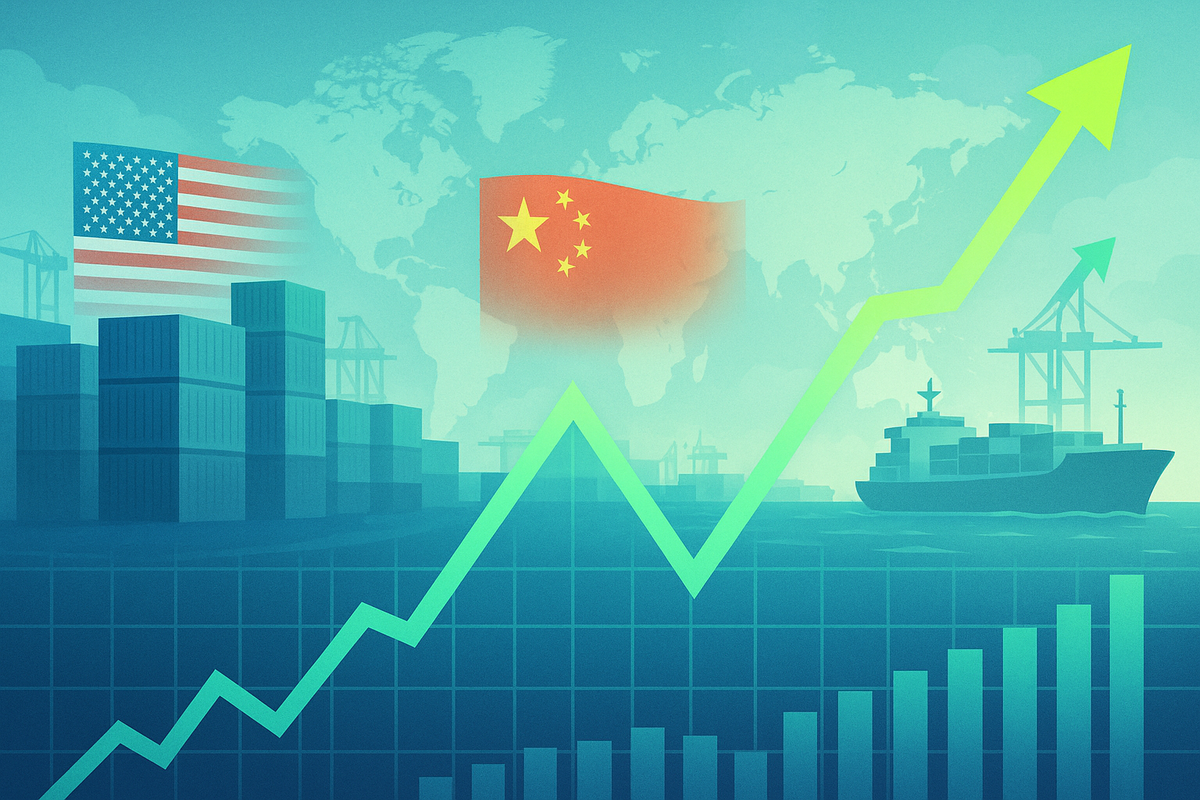
The United States and China have finalized a crucial deal that will prolong important trade agreements, thereby preventing a potentially destabilizing rise in tariffs between the globe’s two largest economies. This decision occurs as international markets have been attentively observing each update in the economic dynamics between Washington and Beijing, with worries that intensifying trade actions might disturb supply networks, elevate expenditures for buyers, and further pressure an already delicate global economy.
The decision to extend the current terms signals a rare moment of cooperation between the two economic powers, whose relationship in recent years has been defined by tension, competition, and mutual suspicion. By agreeing to maintain existing tariff levels rather than allowing them to rise, both governments have managed to buy themselves time for further negotiations—time that many analysts believe is necessary if a longer-term resolution is to be achieved.
This development carries significant implications for a broad range of industries, from technology and manufacturing to agriculture and energy. American exporters who depend on access to the Chinese market had been bracing for retaliatory tariffs that could make their products less competitive. Likewise, Chinese companies reliant on importing components and raw materials from the United States now face fewer immediate cost pressures. The relief on both sides could help stabilize trade flows that have been under strain since the trade disputes intensified in the late 2010s.
The extension agreement, while welcomed by business leaders and investors, is not without its complexities. Negotiators from both sides had to navigate a landscape of competing political pressures, with domestic stakeholders pushing for concessions in key areas such as intellectual property protections, technology transfers, agricultural quotas, and market access. The fact that an agreement was reached at all suggests a willingness—however cautious—to engage in pragmatic compromise rather than allowing economic disputes to spiral into a new trade war.
For U.S. policymakers, the agreement comes as part of a broader strategy to balance economic cooperation with national security concerns. While trade officials have emphasized the benefits of preventing tariff hikes, other arms of the U.S. government continue to impose restrictions on Chinese firms in sensitive sectors such as semiconductors, telecommunications, and advanced computing. This dual approach—cooperation in some areas, strategic containment in others—reflects the complex reality of U.S.-China relations in the 21st century.
China, por su lado, enfrenta varios retos económicos en su territorio, tales como un crecimiento lento, un mercado inmobiliario en dificultades, y un alto desempleo juvenil. Evitar un incremento en los aranceles con EE.UU. ayuda a Beijing a proteger un mercado de exportación esencial en un momento cuando mantener el comercio internacional es crucial para reforzar la estabilidad económica interna. Al aceptar esta extensión, China puede seguir vendiendo productos a los consumidores estadounidenses a precios que probablemente no se vean incrementados por tarifas adicionales, contribuyendo a mantener el empleo en sectores orientados a las exportaciones.
From an international viewpoint, the pact might alleviate some of the doubts affecting the assurance of investors. Financial markets in Asia, Europe, and North America have frequently responded intensely to changes in trade relations between the U.S. and China, with tariff declarations and policy adjustments causing variations in the prices of goods, currency rates, and business profit projections. By taking away the imminent risk of increased tariffs, the prolongation offers a short-term yet noticeable uplift to global economic outlook.
However, experts caution that this is not a resolution but rather a postponement of deeper issues. The structural tensions between the two economies—rooted in differences over governance, industrial policy, and geopolitical strategy—remain unresolved. Issues such as the regulation of state-owned enterprises, enforcement of intellectual property rights, and restrictions on foreign investment will continue to test the durability of any trade arrangement.
In the past, trade agreements between the U.S. and China have been unstable, frequently breaking down due to political tensions or unexpected shifts in the global economic landscape. Over the last ten years, we’ve observed a cycle of deals leading to disagreements, each iteration diminishing the certainty that international business executives desire. Whether this recent extension signals the beginning of a more stable period or just another brief halt before further conflict will largely hinge on the diplomatic and economic choices in the months ahead.
For American businesses, particularly in agriculture and manufacturing, the reprieve could mean continued access to one of the world’s largest and most lucrative markets. Farmers in states like Iowa, Illinois, and Nebraska rely on China as a major buyer of soybeans, corn, and pork, while industrial sectors from aerospace to automotive manufacturing depend on Chinese demand for exports. Avoiding tariff hikes keeps these markets open and competitive, at least in the short term.
Similarly, Chinese firms that import American technology, machinery, and high-quality agricultural products stand to benefit from the extended trade terms. Companies in sectors like electronics manufacturing, automotive production, and food processing rely on U.S. goods for both quality and innovation, making tariff stability an important factor in their long-term planning.
While this development will be welcomed in boardrooms and on trading floors, it also has implications for ordinary consumers. Higher tariffs often translate into higher retail prices, as businesses pass increased costs down the supply chain. By preventing a tariff surge, the agreement may help keep certain goods—from smartphones and electronics to clothing and household appliances—more affordable for consumers in both countries.
In political terms, the extension could be presented by both governments as a win. U.S. officials can claim to have protected American jobs and industries from retaliatory trade measures, while Chinese leaders can frame the agreement as a step toward maintaining economic stability during challenging times. Yet, the underlying competition between the two countries, especially in areas such as artificial intelligence, green technology, and global infrastructure investment, ensures that their relationship will remain both vital and volatile.
For now, the extension stands as a rare moment of cooperation in an era defined by strategic rivalry. Business leaders will hope that this fragile truce can evolve into a more lasting framework for trade, while policymakers on both sides will remain mindful that the balance between economic interdependence and national security interests is more delicate than ever.
Whether the current agreement will pave the way for broader reforms or simply delay the next phase of tariff tensions remains to be seen. But for the moment, the world’s two largest economies have taken a step—however temporary—toward stability, offering a measure of relief to global markets and a reminder that even in an age of competition, dialogue and compromise still hold value.